LONDON TREE CARE / Clapham
Tree Surgery Clapham
Tree work in Clapham often begins with a question about a boundary: who owns the tree, which branches are causing difficulty and how access can be agreed. The individual property matters more than a broad neighbourhood label. A crown may extend over several gardens while the trunk stands well inside one plot. Describe the ownership position and the result you want before choosing pruning or removal.
- Boundary ownership made clear
- Neighbour access agreed before work
- A balanced retained crown

Home / London coverage / Clapham
Tree Surgery London receives enquiries for Clapham and helps customers set out the practical details needed for a useful assessment, including any conversations already held with neighbours. The wider Tree Surgery London service covers enquiries about appropriate tree management, while this guide explains how to manage the relationship between neighbouring gardens.
Check authority requirements for the identified boundary tree
Before agreeing a start date, establish the relevant authority and the tree’s protection position; consult the official information about Tree Preservation Orders and conservation areas rather than relying on a neighbouring property’s history.
Where an application or notification is required, describe the proposed work clearly; uncertainties should be referred to the relevant authority instead of resolved by a guess about what normally happens.
The property-specific planning question is how the proposed work addresses branches extending over a neighbouring garden where screening, clearance and ownership need to be discussed together without getting ahead of the checks required for that address.
Manage an overhanging crown without arbitrary cuts
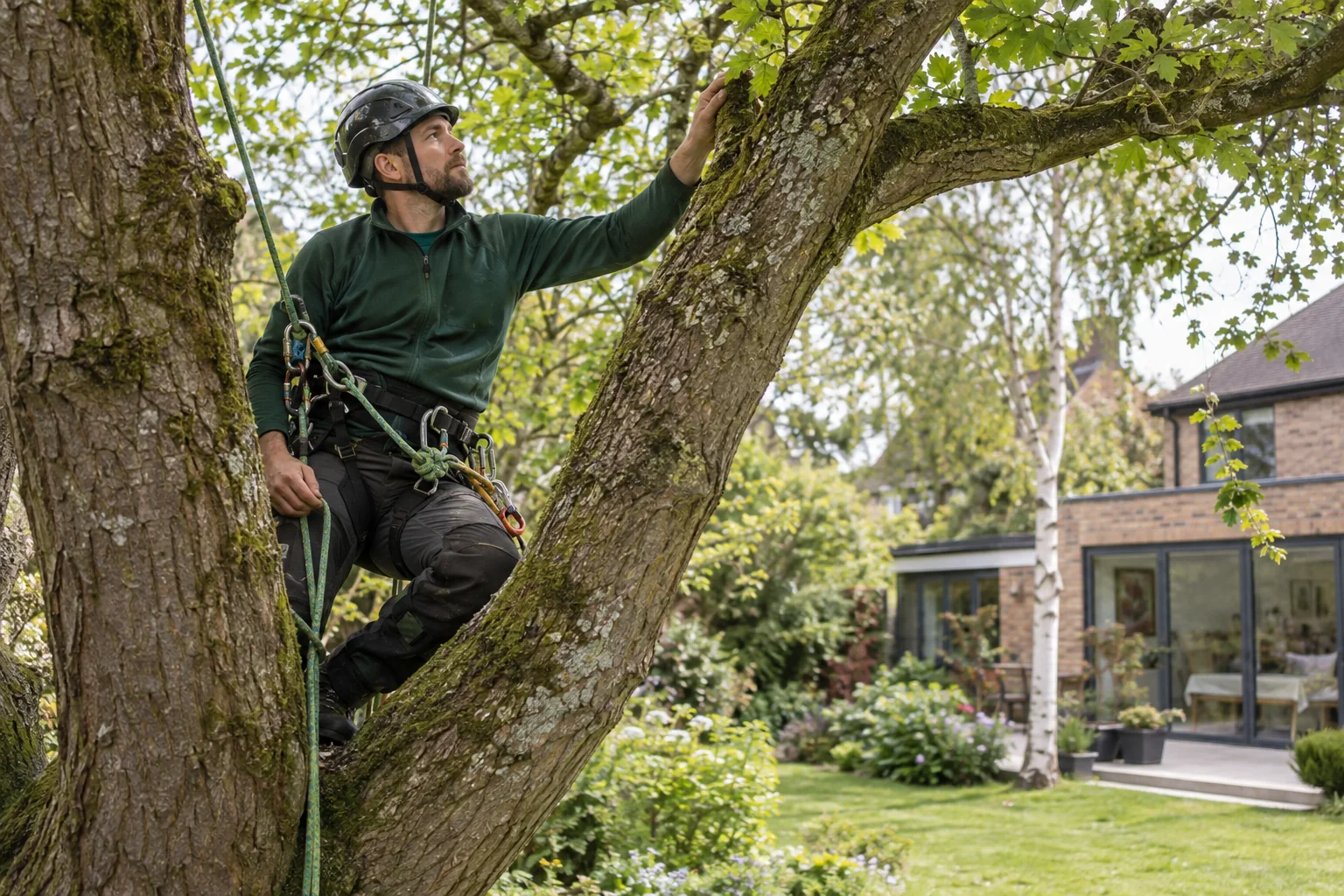
A sensible pruning discussion here would focus on a balanced crown specification that considers the tree as a whole rather than treating the boundary line as an instruction to make arbitrary cuts.
A written pruning proposal should show what will remain after the cuts; include which part of the canopy is affected and how the proposed treatment relates to the original problem.
Taking more foliage off does not automatically produce a more durable improvement; the provider should explain any limitations instead of implying that one visit can remove all future maintenance needs. Use the pruning service overview to compare the terminology; then ask how the selected approach relates to the result required at the property.
| Planning decision | Information to provide | What to agree |
|---|---|---|
| The reported concern | The location of the trunk in relation to the boundary and the specific branches causing contact or obstruction | An assessment and a defined management objective |
| The retained crown | A balanced crown specification that considers the tree as a whole rather than treating the boundary line as an instruction to make arbitrary cuts | An understandable pruning scope, if work is appropriate |
| The working route | Permission to use an adjoining garden for part of the operation, with the agreement recorded before the work date | Method, protection and workable site separation |
| The finished space | A boundary bed containing established shrubs that must be distinguished from material marked for clearance | Stump, material and reinstatement responsibilities |
Settle neighbour access before the operation
At the planning stage, pay particular attention to permission to use an adjoining garden for part of the operation, with the agreement recorded before the work date.
Access information should cover the entire journey between the work area and collection point; include narrow turns, steps, overhead obstructions and surfaces that may be unsuitable for the intended equipment.
The contractor needs a workable separation between the operation and occupied space; a named site contact should be available to resolve an access problem rather than leaving it to an uninformed occupant.

Locate the boundary issue on the whole tree
Begin with what you can actually see rather than deciding which operation the tree needs; include dates, affected parts and any recent work around the tree so the history can be considered alongside its present appearance.
For this enquiry, useful starting evidence would include the location of the trunk in relation to the boundary and the specific branches causing contact or obstruction.
A remote conversation should make clear the limits of the information available; further assessment may be necessary where the reported symptom has more than one plausible explanation or its extent remains unclear. Use the tree care service information to prepare assessment questions; keep the symptoms of the individual tree at the centre of the conversation.
Price the authorised work, not an unresolved request
Compare the written scope before comparing the total price; include access arrangements, material handling, waste disposal and any stump treatment that is to form part of the visit.
The difficulty of protecting structures or managing shared access can influence the proposal; this matters especially where material must be moved in small sections or an occupied site requires carefully timed access.
For this particular brief, the scope should explain its response to branches extending over a neighbouring garden where screening, clearance and ownership need to be discussed together, rather than substitute an unrelated standard operation.
Separate a boundary disagreement from removal advice
A felling proposal needs a clear explanation of why that outcome is appropriate; the condition, practical conflict and restrictions should be understood before the operation is arranged.
A removal method must account for the work space and the objects within reach; the proposed approach should be explained after the contractor has checked access and the space available for material.
The ground-related part of this decision is a boundary bed containing established shrubs that must be distinguished from material marked for clearance. Read the sectional removal guidance when reviewing a felling proposal; the contractor is responsible for assessing the method appropriate to the actual site.
Protect the planting beside the boundary stump
For the space left at ground level, consider a boundary bed containing established shrubs that must be distinguished from material marked for clearance.
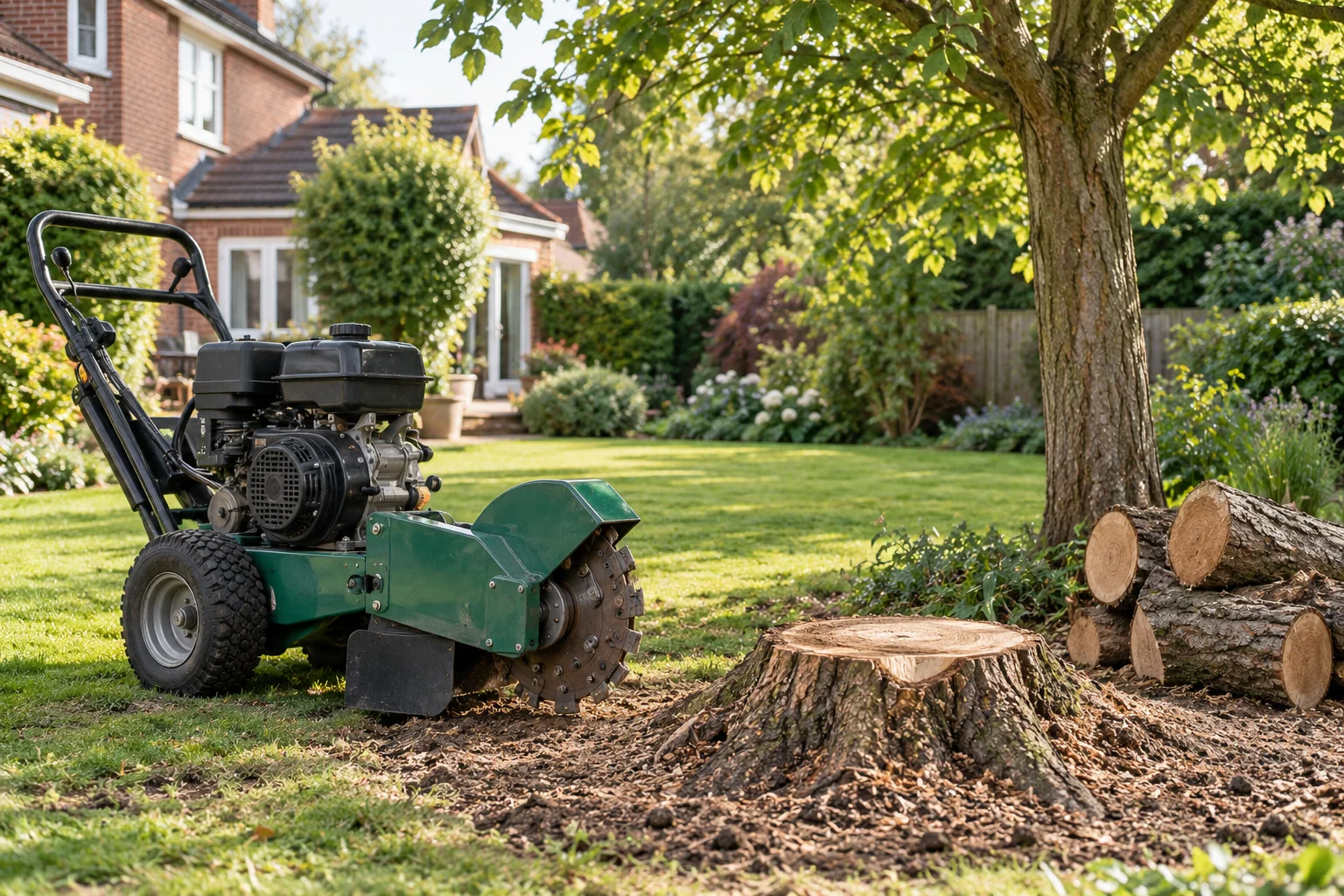
Discuss what the ground will be used for before selecting a stump treatment; preparing a planting position, returning an area to lawn and forming a new hard surface are different tasks.
If another contractor will complete the garden work, establish the handover condition; confirm whether removal of roots or replacement of soil is included before accepting the quotation. Read the guide to stump grinding before agreeing the finished ground condition; specify any further soil preparation that the owner expects after the machine work.
Keep a record of the agreed boundary clearance
A useful follow-up for this property would consider new contact with a fence, neighbouring planting or a frequently used path as the retained crown develops.
The retained tree should have a realistic management plan beyond the day of pruning; include a new crack, hanging growth or a noticeable change in condition that should not simply wait for a routine maintenance date.
An ongoing record is most helpful when it shows dates and the part of the tree concerned; but do not climb, pull a suspect limb or excavate around roots in an attempt to test the tree yourself.
Decide which garden receives retained timber
Material handling deserves a separate line in the job specification; retaining logs for a future use is a different instruction from leaving a mixed pile of branches and foliage.
The size and location of any retained pieces should be agreed in advance; discuss chip separately if it is intended for a garden use that requires suitable material.
The completion check should include new contact with a fence, neighbouring planting or a frequently used path as the retained crown develops.
Arrange an informed Clapham enquiry
Use the details in this guide to describe branches extending over a neighbouring garden where screening, clearance and ownership need to be discussed together. Explain who can attend or provide access at the property; any restriction on appointment times or access should be made clear before a visit is arranged. The enquiry can be considered with a suitable provider through Tree Surgery London; the actual operation and price should be based on the tree and property rather than a generic area description.
For another property nearby, the guides to tree work in Brixton and Balham tree surgery offer separate practical starting points. The nearby guides should not replace a check of the actual address and tree; site dimensions and tree protection cannot be inferred from the arrangements at another location.
Local permission checks for Clapham
Clapham needs an address-level authority check because the area and its common relate to both Lambeth and Wandsworth. Lambeth's own information confirms that Clapham Common straddles the boroughs, while its conservation profile describes the Clapham conservation area. A familiar local landmark therefore does not identify the correct planning department for every nearby private tree. Use the property's exact location and current borough mapping before applying for work.
Distinguish common or public-land trees from trees in a garden. Report public-tree concerns to the responsible manager instead of arranging unauthorised cutting. For private work, check the relevant council's TPO and conservation requirements, then establish landowner consent and access. A photograph should show the tree's position relative to the boundary as well as the branch causing concern. Ask the arborist to set out a measurable objective and explain what crown will remain. That supports a decision based on the particular tree, without assuming that proximity to the common creates the same conditions or permissions for every property.
Questions about tree work in Clapham
Can I book work on a neighbour’s tree?
Establish ownership and what the owner has authorised before arranging an operation. Explain the boundary situation at enquiry stage. If there is disagreement, obtain appropriate advice rather than asking an operative to resolve it on the work day.
What if access is only possible through another garden?
The access agreement should be settled in advance and explain the route, timing, protection and reinstatement expected. A quotation based on access that has not been secured may need to change when the actual arrangements are known.
What should I send with a Clapham tree-work enquiry?
Begin with a short explanation of the desired result and clear site photographs; then include the narrowest access measurement and say who can authorise work if that person will not attend the visit.
How should I check tree protection at my Clapham address?
Use the exact property details to identify the relevant planning authority; a nearby property’s status or an old permission does not automatically answer the question for this tree.
What affects the quotation for tree surgery in Clapham?
Quotations should account for the agreed crown work or removal and the practical site constraints; do not assume a standard price can cover every route, tree condition and material-handling arrangement.
What should be agreed about clear-up at the Clapham property?
The finish should distinguish removal of cut material from soil replacement or surface reinstatement; the final check can refer to a shared understanding instead of competing expectations about the same quotation.