
TREE SURGERY LONDON / CONSIDERED OUTDOOR CARE
Tree Pruning in London
Pruning should have a defined purpose: managing a particular branch, improving clearance or adjusting a crown that has outgrown its setting. It is not simply a matter of removing as much foliage as possible. Discuss the tree’s species, condition and previous treatment so the proposed cuts can be considered in relation to its future growth.
- Crown reduction, thinning and lifting explained
- A specification based on the intended outcome
- Timing, permission and waste checks before the visit
Decide what needs to change
Begin with the practical issue. A branch rubbing on a roof is not the same problem as a low canopy over a path or an overextended limb. Describing the outcome helps distinguish a small amount of selective work from a wider crown operation. Photographs taken from several positions are useful, because a canopy that appears balanced from one window may look different from the other side of the garden.
The tree’s normal shape also matters. Trying to make every species fit the same outline can result in unnecessary wounds and repeated maintenance. Discuss the effect on future growth, not only the appearance immediately after cutting. A recommendation to leave some branches alone can be part of a considered pruning plan.
Three different crown operations
| Operation | Primary change | Important limitation |
|---|---|---|
| Reduction | Height or spread | Not indiscriminate topping |
| Thinning | Internal crown density | Does not deliberately reduce the outer size |
| Lifting | Clearance below the crown | Large low branches may be unsuitable for removal |
| Selective branch work | A particular branch or defect | Not every issue requires whole-crown pruning |
Crown reduction changes dimensions
Crown reduction shortens selected branches to suitable growth points to reduce the height or spread of the canopy. The extent must be appropriate to the tree and its condition. A specification should make the intended result understandable, rather than relying on an unexplained percentage or a request to make the tree smaller.
Reduction is different from topping. Indiscriminate cuts can leave a poor framework and create further management problems. Ask how the outline and remaining structure will be treated. A tree that has previously been heavily cut may require a different approach from one with an intact crown, and a single visit may not achieve every desired change responsibly.
Crown thinning changes density
Thinning involves selected work within the canopy while retaining its overall dimensions. It is not a smaller version of reduction and should not be presented as a guaranteed way to transform the light in every room. Buildings, orientation, neighbouring vegetation and the tree’s natural leaf density also influence shade.
Removing too much inner growth can leave an unsuitable distribution of foliage. The proposal should explain why thinning is relevant and how the retained structure will be considered. If the real problem is that the outer branches extend too far, a discussion about reduction may be more useful than asking for thinning by name.
Crown lifting creates clearance below
Lifting removes or shortens selected lower branches to provide space under the crown. It may help a path, driveway or garden feature, but the size of the branches and the amount of remaining live crown are important constraints. Removing several large low limbs simply to expose the trunk is not automatically appropriate.
Show the contractor where clearance is needed and how the space is used. A conservative adjustment to a particular branch may achieve more than lifting the whole crown. If a vehicle route is involved, explain the actual clearance requirement and the property boundaries; do not assume that every branch visible from the drive belongs to the same owner.
Dead, rubbing and damaged branches
A pruning enquiry can concern individual defects rather than the whole canopy. Dead branches above frequently used areas may warrant attention, while some deadwood in a low-risk location can have habitat value. Rubbing or damaged branches need assessment in the context of the tree, not automatic removal based on a close-up photograph.
New cracks, hanging limbs or recent movement should be described clearly and treated cautiously. Keep away from unstable material. For a wider concern about vitality or recurring decline, tree care is the more relevant starting point. Pruning can address certain structures, but it does not diagnose every cause of poor growth.
Timing and wildlife
The suitable time for pruning varies with the species, the purpose of the work and the tree’s condition. A general recommendation to prune during dormancy has exceptions. Explain if you are trying to manage fruit, blossom, shade or damaged wood, because the reason for the work affects the advice you need.
Active bird nests and other wildlife constraints must be checked independently of the season. A date in the diary is not proof that the canopy is clear. If protected wildlife is present, the proposed operation may need to change or wait. Obtain site-specific advice rather than treating a pruning appointment as permission to disturb a nest or roost.
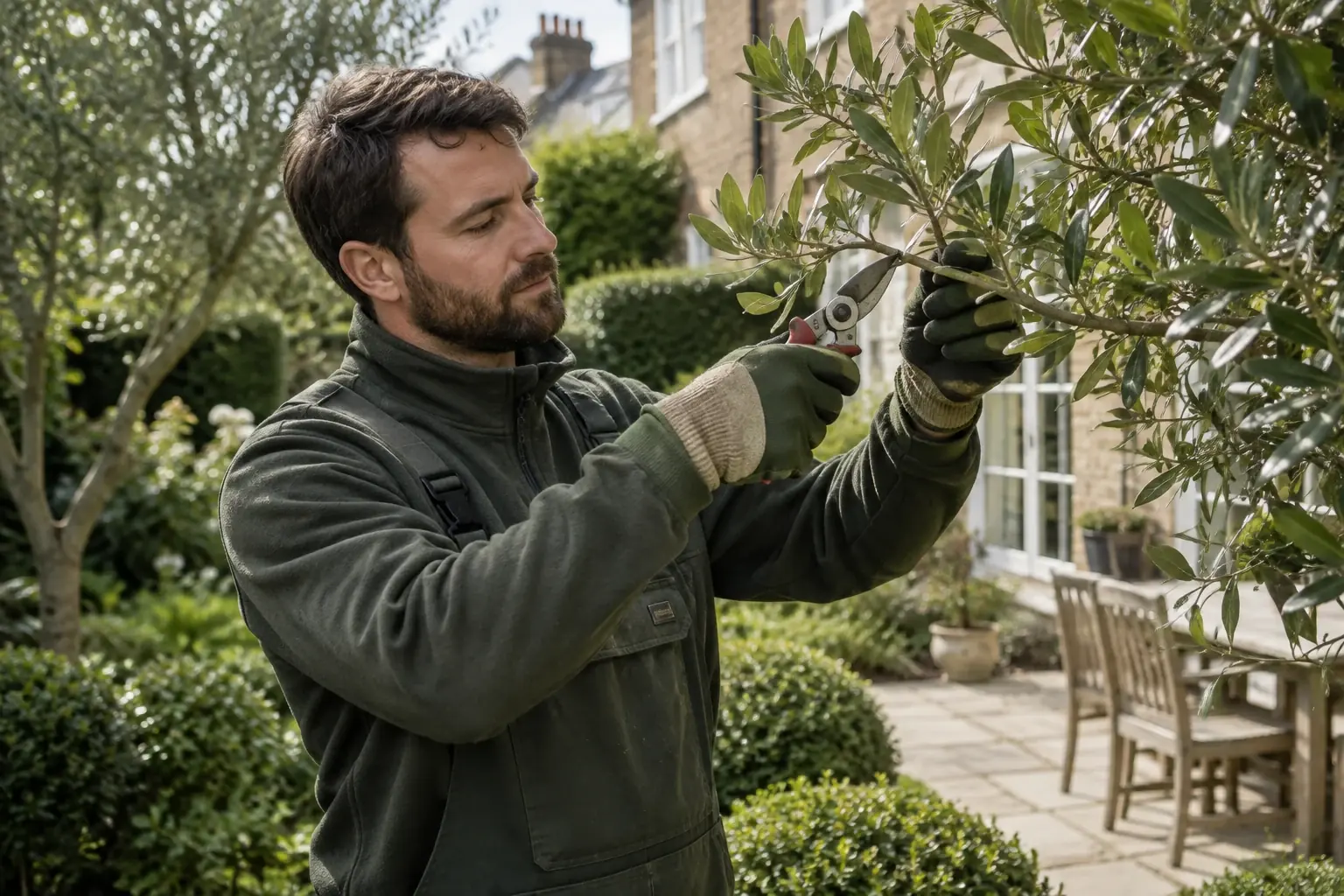

Working above a garden
Large branches over a greenhouse, patio or boundary require an appropriate method for controlling material. Access may involve climbing or another suitable means, depending on the tree and site. These are decisions for competent professionals; a description of the desired result is not a set of instructions for carrying out aerial work yourself.
Before the visit, identify garden furniture, fragile planting and the route for taking branches away. Confirm who will move items and where the work area will be kept clear. If you are uncertain about the type of contractor or the scope of a visit, the tree surgeon service explains what to establish when arranging work.
The quotation and the material left behind
The amount of pruning, access, branch handling and clearance influence the price. Ask what is included in processing and removing the cut material. Keeping logs may be possible, but moving, cutting and stacking them to a particular size or location needs agreement. Woodchip retained in the garden is different from a complete removal service.
General gardening services may suit lower-level maintenance tasks, but should not be assumed to cover large-tree operations. Conversely, a tree-work quotation does not automatically include routine border maintenance. Distinguishing the jobs helps prevent a visit from being expected to achieve several unrelated outcomes.
Permission and the limits of pruning
Check for a Tree Preservation Order and conservation-area controls before work is authorised. Give the council an identifiable tree and a clear proposal where required. Permission to carry out one operation does not necessarily cover further work suggested on the day. Keep the decision with the agreed specification.
Some trees cannot reasonably be reshaped to fit a new use of the garden. Others may have defects or a history that limits further pruning. Where retention is being reconsidered, tree felling and controlled removal explains a separate set of decisions. Removal should be discussed on its merits, rather than reached through a sequence of increasingly severe cuts.
USEFUL ANSWERS
Questions about this service
Which is better: reduction or thinning?
They address different aims. Reduction changes the outside dimensions; thinning changes selected growth within the existing outline. Explain the actual problem with space, clearance or density and ask which approach is appropriate to the tree, rather than choosing a term because it sounds less severe.
Can you guarantee more light after pruning?
The result depends on the tree, the work agreed and the wider setting. Roofs, neighbouring buildings and the direction of sunlight can limit the effect. Discuss realistic expectations, particularly where a request for more light would require excessive removal of live growth.
How should pruning be described in a quote?
The tree should be identifiable and the intended operation and extent clear. If the proposal uses dimensions or a percentage, ask what those describe. A shared understanding of the retained crown is more useful than a loose promise to give the tree a tidy shape.
Does a heavily pruned tree need more cutting later?
Previous severe work can influence regrowth and future management. The appropriate response depends on the retained structure and condition. Mention earlier work and provide older photographs if available, so the next visit can be considered as part of the tree’s history.
Can a low branch be shortened instead of removed?
Sometimes a selective reduction can provide useful clearance without removing the entire limb. The branch’s size, position and condition matter. Ask for an assessment of the options; a close-up image alone may not show how the branch fits into the crown.
Is pruning the same as a tree health assessment?
No. A pruning visit concerns specified practical work. Concerns about decline, structural condition or a report required by another organisation may need a different assessment. State those concerns at the enquiry stage so they are not treated as an incidental extra.
A CLEAR NEXT STEP
Tell us about the work
Explain the clearance, canopy or branch concern rather than simply asking for a smaller tree. Confirm the proposed operation, its intended extent, suitable timing and the treatment of cut material in the written quotation.
For local guidance on pruning objectives and permission checks, read about tree care in Brixton and planning work on Chelsea garden trees.