
TREE SURGERY LONDON / CONSIDERED OUTDOOR CARE
Tree Surgeon Services in London
A useful conversation with a tree surgeon starts with the tree and the problem, rather than a request to cut everything back. Tree Surgery London helps arrange enquiries for pruning, removals and related tree work. Describe your property, what you have noticed and the outcome you need, so the proposed service can be assessed and specified properly.
- Discuss the tree and its surroundings
- Separate practical work from specialist reports
- Agree the contractor, specification and quotation
Choosing the right kind of help
A tree surgeon carries out practical tree work, which may involve pruning, climbing, dismantling and handling timber. An arboricultural consultant may instead be commissioned to investigate a defect, prepare a formal report or advise on a planning matter. The roles can overlap, but a booking for routine work is not automatically a commission for an independent written opinion. Explain who needs the advice and what decision it must support.
For a homeowner, the immediate concern might be a limb over the roof or limited clearance in a small garden. A managing agent may need a defined programme for several trees and arrangements for residents. These are different briefs. A good enquiry gives enough context to identify the next useful step without pretending that every tree can be diagnosed over the telephone.
Start with observations, not a diagnosis
Tell the person handling the enquiry what has changed. Useful details include when a branch broke, whether foliage has become sparse, or whether building work recently took place near the roots. Photographs should show the whole tree as well as the area of concern. Include a view of the route into the garden; access can be as important to the quotation as the crown itself.
Avoid deciding that a tree is dangerous simply because it is tall, or that it needs removal because it stands close to a building. Size and proximity are part of an assessment, not a conclusion. If there is obvious fresh movement, a hanging limb or another immediate concern, keep people away and seek appropriate urgent assistance. Do not climb the tree or move damaged branches to obtain better photographs.
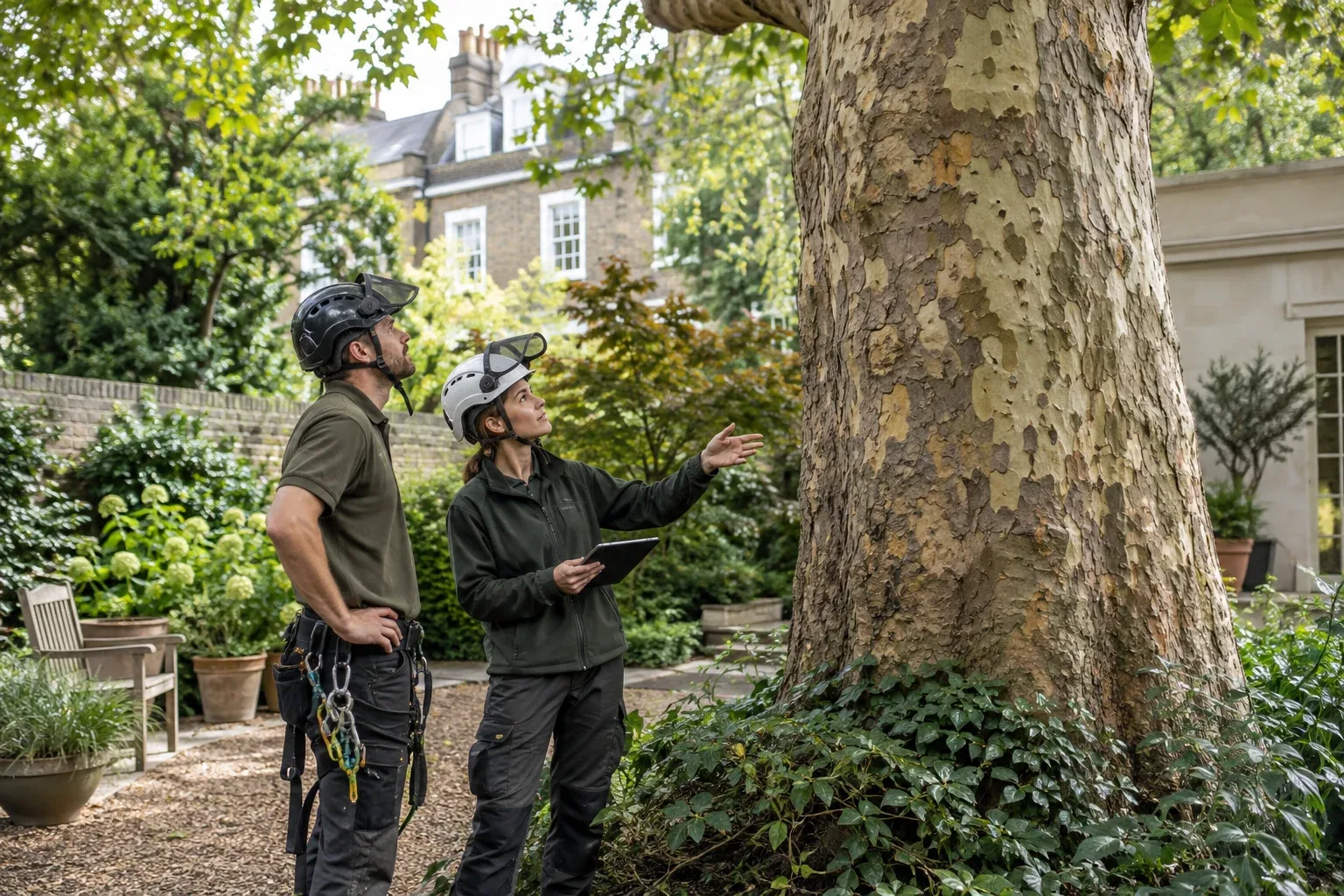
Which kind of tree enquiry?
| Your requirement | What to discuss | What to confirm |
|---|---|---|
| Practical pruning | The specific branch or clearance issue | A precise work specification |
| A report for another organisation | The report’s purpose and recipient | Who is competent to prepare it |
| Removal | Why retention may be unsuitable | Method, access and stump treatment |
| Recurring management | History and changing conditions | A proportionate review plan |
What a work specification should tell you
The written scope should identify the tree and describe the intended result. For pruning, ask how the extent and purpose will be expressed. For removal, establish whether the stump is included. An instruction such as “tidy tree” leaves too much open to interpretation, particularly where the tree belongs to a shared property or several people have different expectations.
The quotation should distinguish included tasks from items needing another visit, permission or specialist investigation. Ask what happens if the inspection reveals a condition that changes the proposed method. Changes should be discussed before additional work proceeds. A clear record helps both customer and contractor understand what has been authorised.
Questions about the appointed contractor
Tree Surgery London’s published terms describe an introductory service, with the work contract made with the relevant service provider. Confirm the provider’s identity, the person responsible on site and the terms applying to the particular booking. Do not assume that photographs, a branded website or a reference to tree surgery establish the qualifications of the people attending.
Ask for evidence of training relevant to the proposed operations and current insurance appropriate to the work. If climbing is involved, ask how the operation and rescue arrangements will be planned. Equipment should be selected for the site and task, rather than treated as proof of competence in itself. Keep copies of the quotation and supporting information where the work is commissioned on behalf of a landlord or residents’ organisation.
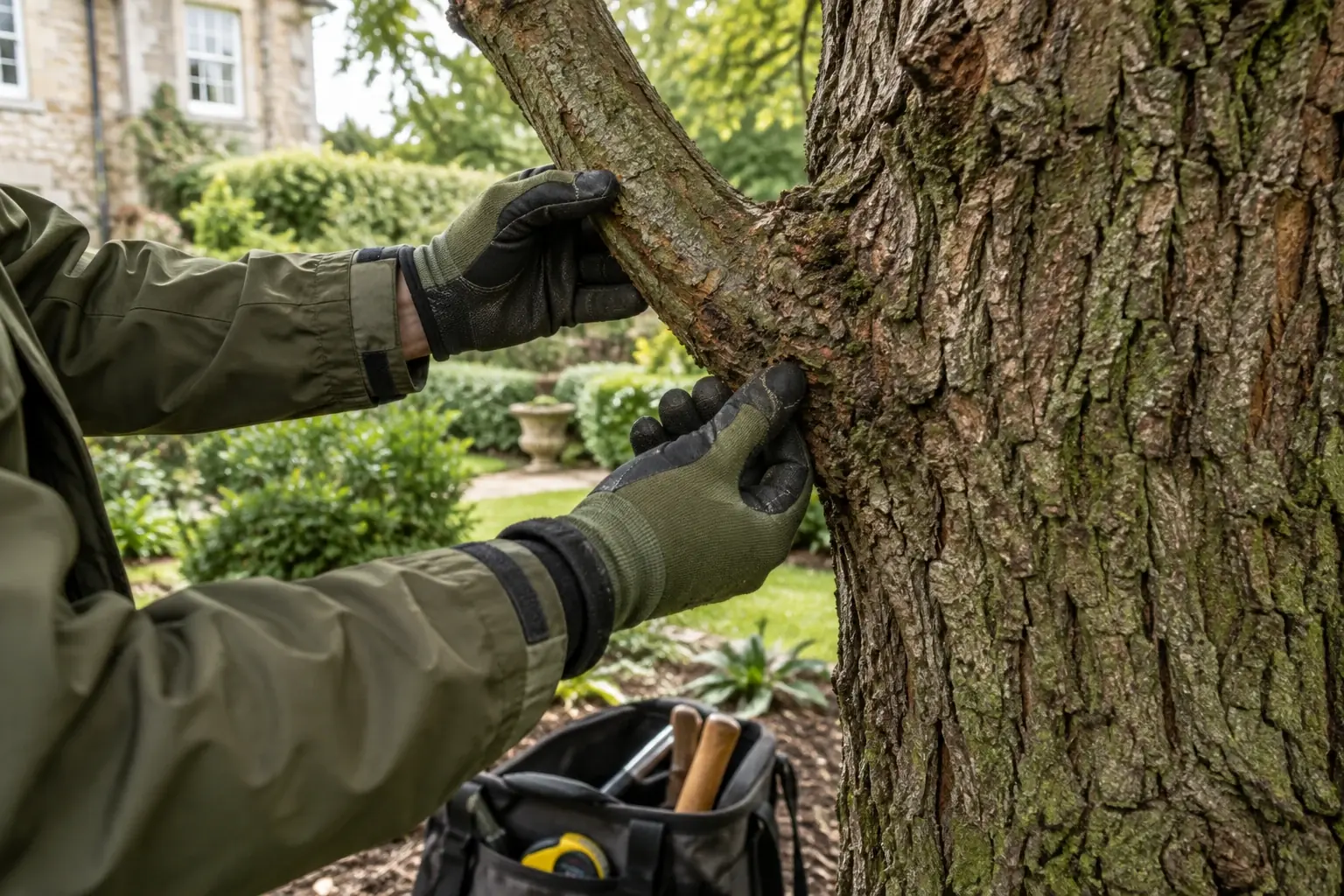
A London garden changes the work plan
Terraced properties can have narrow side passages, steps, delicate paving or no external access to the rear. Mention shared routes, doors through the building, parking restrictions and any limits on working hours. Neighbours may need to be consulted about access or temporary disruption, but permission to use their land should not be assumed.
The assessment also needs to consider roofs, overhead cables, garden buildings and the space available for lowering and processing material. Work beside a public path or road may require further arrangements. These details affect the method, staffing and time, so a comparison based only on the height of the tree can be misleading.
Keep the options proportionate
Where a tree can be retained, tree pruning may address a specific branch or clearance problem. Tree care considers longer-term management and growing conditions. Neither should be described as a universal cure: the tree’s condition, species and previous treatment still matter.
If retention is unsuitable, discuss tree felling and sectional removal. After removal, stump grinding is a separate method with its own access and ground checks. Knowing how these services differ makes it easier to request an appropriate quotation rather than combine unrelated expectations into a single vague booking.
Permissions, wildlife and the date of work
Before a date is fixed, establish whether the tree is protected by a Tree Preservation Order or lies in a conservation area. The borough’s planning or tree officer service is the appropriate place to confirm uncertainty. Keep any decision and make sure the authorised specification matches the intended work. Ownership of the tree is not, by itself, permission to alter it.
Wildlife checks are separate from planning permission. Active nests and protected species can affect the timing or method. A proposed visit may need to change if a constraint is found. Ask who will check the site and how an unexpected restriction will be handled, rather than relying on a calendar date as evidence that work can proceed.
Budget, clearance and the final review
Access, condition, the amount of material and the proposed operation all influence the price. Compare written quotations for the same scope, including applicable VAT and waste handling. Say whether you want logs retained and where they can be placed. Removing all material, cutting logs to a usable size and dealing with a stump are different requests.
After the work, review the site against the agreed specification. The question is whether the authorised tasks and clearance have been completed, not whether every tree now looks newly shaped. Trees are living structures; appropriate work can be selective and visually modest. Retain the paperwork and any follow-up recommendations so later decisions can take account of what has already been done.
USEFUL ANSWERS
Questions about this service
Do I need a tree surgeon or a consultant?
Practical pruning and removals are normally discussed with a tree-work contractor. A report for an insurer, planning application or dispute may require a separately commissioned consultant. State the purpose of the advice before booking so the right type of service can be identified.
Can I obtain a firm quotation from one photograph?
A photograph can support an initial estimate, but it may not reveal access restrictions, defects or the amount of timber involved. Ask whether the figure is provisional and what needs checking on site before it becomes an agreed quotation.
Who will be responsible for the actual work?
Confirm the identity of the appointed service provider and read the booking terms. The published business model involves introductions to providers; it should be clear who is quoting, carrying out the work and dealing with any concern afterwards.
Is an annual pruning visit always necessary?
No fixed cutting interval suits every tree. Species, age, condition, location and previous management determine what is useful. Some visits may result in observation or advice rather than pruning. Ask what problem the proposed repeat work is intended to address.
What should a managing agent prepare?
Identify the trees, the decision-maker, resident access arrangements and any existing survey or permission. Explain how the work will be authorised and who can agree a change in scope. Shared gardens often need more coordination than a straightforward single-household booking.
Can the enquiry include a damaged or fallen tree?
Describe the circumstances and keep people clear of unstable material. Availability and the appropriate response must be confirmed for that situation. Do not treat a general enquiry number as a guarantee of an immediate emergency attendance.
A CLEAR NEXT STEP
Tell us about the work
Describe the tree, the change you have noticed and why you want advice. Ask who will assess the site, what the appointment covers and whether a separate written report is needed before work is specified.
For address-level planning questions, compare the Kensington arborist guide with the guidance on arranging tree work in Stratford.