LONDON TREE CARE / Balham
Tree Surgery Balham
“Make it smaller” can describe several different jobs. A Balham owner may want more room above a path, less contact with a building, a more balanced canopy or an assessment of a damaged branch. Those concerns should be separated before a pruning specification is written. Tree Surgery London accepts enquiries across Balham and helps customers provide the information a tree-work provider needs.
- Describe the actual obstruction
- Compare the intended crown result
- Avoid arbitrary pruning instructions

Home / London coverage / Balham
Explain what is changing, where it affects the property and what you hope to retain. An agreed objective makes the proposed work easier to compare and review. The wider Tree Surgery London service covers enquiries about appropriate tree management, while this guide explains how to use a clear pruning objective rather than an arbitrary size.
Translate make it smaller into a pruning objective
A sensible pruning discussion here would focus on the distinction between lifting selected lower branches, thinning appropriate growth and reducing the crown’s spread.
Translate a general wish for a smaller tree into an understandable specification; the aim is that two different quotations are not being compared as though they described exactly the same operation.
Pruning changes a living structure rather than freezing it at a chosen size; a realistic plan recognises that the tree will continue to develop and may require reassessment as circumstances change. Explore the tree pruning service alongside the proposed specification; allow the actual tree and the desired outcome to determine what is appropriate.
Identify which part of the crown is causing difficulty
The first inspection is more useful when the background is specific and factual; show the whole tree as well as the reported feature, because a close-up alone can conceal its position within the crown.
For this enquiry, useful starting evidence would include which branch or canopy area creates the obstruction and whether that has changed gradually or suddenly.
Some questions cannot be resolved from an image sent with an enquiry; an operation should not be selected solely because it appears to offer the quickest response to the concern described. Further tree condition and care guidance can help frame an enquiry; a site inspection should be used where the available evidence does not resolve the concern.
Compare the retained crown behind each price
A clear price depends on a clear description of the job; the aim is that a lower figure is not being accepted for an operation that leaves important parts of the requested work undone.
Time and resources can be affected by the handling route as much as the amount of growth; ask which assumptions would need reviewing if the actual conditions differ from those described at enquiry stage.
For this particular brief, the scope should explain its response to a tree whose size is being questioned even though only one part of the crown is causing a practical difficulty, rather than substitute an unrelated standard operation.

Create handling space without sacrificing retained planting
At the planning stage, pay particular attention to a small work area where retained planting and household storage restrict the space for stacking arisings.
The practical method depends on more than the width of the first gate; use clear measurements rather than an estimate based on whether a person can comfortably walk through.
Agree the protection and exclusion arrangements for the actual operation; allow the provider to change the arrangement if the inspected conditions require a different method.
| Planning decision | Information to provide | What to agree |
|---|---|---|
| The reported concern | Which branch or canopy area creates the obstruction and whether that has changed gradually or suddenly | An assessment and a defined management objective |
| The retained crown | The distinction between lifting selected lower branches, thinning appropriate growth and reducing the crown’s spread | An understandable pruning scope, if work is appropriate |
| The working route | A small work area where retained planting and household storage restrict the space for stacking arisings | Method, protection and workable site separation |
| The finished space | Keeping the root area of retained trees separate from any proposal to grind an unrelated stump | Stump, material and reinstatement responsibilities |
Use a clear crown description in protection checks
The enquiry should establish who is responsible for checking protected status; an online map or previous conversation may not establish the requirements for the operation now being proposed.
Use identifiable trees and an understandable pruning or removal description in the relevant paperwork; check the decision and conditions before assuming that a quotation amounts to permission to proceed.
The property-specific planning question is how the proposed work addresses a tree whose size is being questioned even though only one part of the crown is causing a practical difficulty without getting ahead of the checks required for that address.

Assess removal separately from a size preference
The decision to remove a tree deserves the same care as the method used to remove it; avoid treating a large canopy or an inconvenient position as a complete assessment on its own.
Buildings or retained features can restrict the ground below; the agreed scope should say how the resulting timber is to be reduced, retained or removed from site.
The ground-related part of this decision is keeping the root area of retained trees separate from any proposal to grind an unrelated stump. More detail about felling and sectional dismantling is available in the service guide; make sure the proposed material handling fits the access described in the enquiry.
Keep unrelated stump work outside the root area
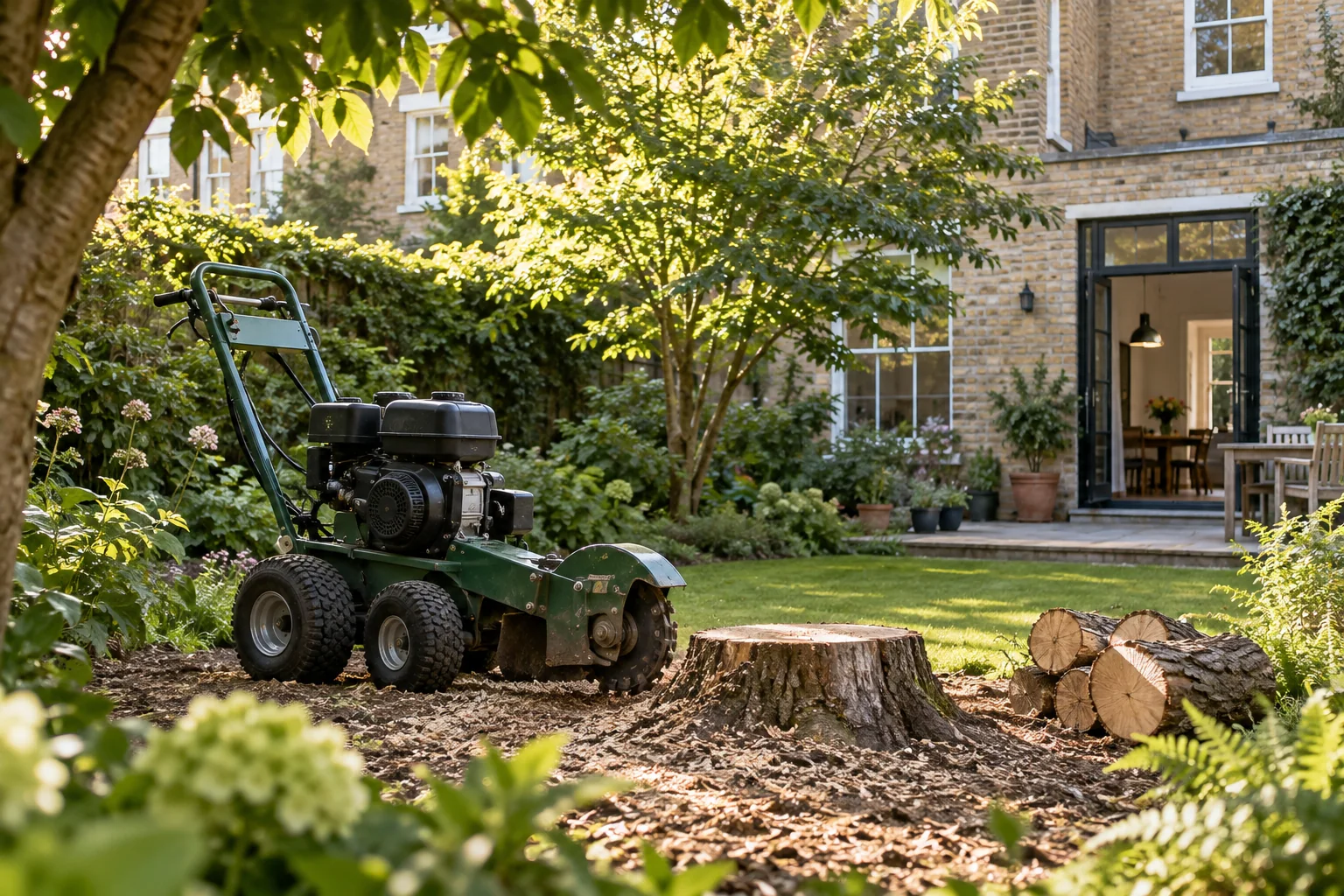
For the space left at ground level, consider keeping the root area of retained trees separate from any proposal to grind an unrelated stump.
The required ground finish depends on the next use of the space; make clear whether the work includes removing grindings, bringing in suitable soil or restoring a finished surface.
After grinding, the remaining mixture needs to be considered in relation to the intended finish; ask what is included in the preparation and who will deal with any further soil or reinstatement work. Use the grinding service information to prepare questions about the operation; the exact position and intended future use should be checked at the property.
Judge whether the original obstruction is resolved
A useful follow-up for this property would consider whether the original obstruction has been resolved without creating an avoidable imbalance in the remaining crown.
Keep the agreed objective available when judging the result later; remember that a tree remains a living structure whose growth and surroundings can change over time.
Photographs taken from a repeatable position can help explain a later concern; the limits of visual observation should be recognised rather than treated as a substitute for competent assessment.
Define the arisings and storage arrangements
Do not leave the treatment of cut material to an assumption on the work day; identify an accessible storage position if any wood is to be kept rather than collected with the other arisings.
Retained wood needs an agreed position that does not obstruct access or the remaining work; a piece that can be handled by the contractor may still be too heavy for the owner to move afterwards.
The completion check should include whether the original obstruction has been resolved without creating an avoidable imbalance in the remaining crown.
Arrange an informed Balham enquiry
Use the details in this guide to describe a tree whose size is being questioned even though only one part of the crown is causing a practical difficulty. Identify the tree and the person who can approve the proposed work; mention documents or photographs that will help the provider understand the concern. Tree Surgery London accepts the enquiry and can help organise the initial conversation; the provider establishes what assessment and scope are appropriate for the particular request.
For another property nearby, the guides to tree work in Clapham and Tooting tree surgery offer separate practical starting points. The neighbouring area links help orient a new request; the ownership position and applicable permissions should be established for the tree concerned.
Local permission checks for Balham
Balham is a useful reminder that an everyday place name and a council area are different things. Wandsworth is the principal authority to check for much of the district, but Lambeth also has official records using Balham addresses. Establish the council for the property before sending a protection enquiry. The relevant authority follows the location of the tree, not the postcode label used in a general search.
Once that is clear, check both individual TPOs and conservation-area controls. For a tree beside a boundary or shared route, identify the owner and the people who can agree access. A resident's permission to enter a communal area may not amount to permission to use it as a work zone. Give the arborist photographs of the crown, trunk and proposed handling route. A specific explanation of the desired clearance or observed damage helps define the work. Keep that specification with the statutory decision and private access agreements, reducing the chance that different parties are discussing different operations.

Questions about tree work in Balham
Are crown lifting and crown reduction the same job?
No. Lifting addresses selected lower branches to provide clearance, while reduction shortens the crown’s dimensions through suitable cuts. Explain the problem to be solved so a provider can discuss which treatment, if any, is appropriate.
Can I compare quotes that use different pruning terms?
Ask each provider to explain the intended retained crown and the branches or dimensions affected. A broad label is not enough to compare scope. Disposal, access arrangements and any follow-up should also be clear.
What should I send with a Balham tree-work enquiry?
Explain the tree location, ownership position and the outcome you hope to achieve; alongside any existing tree report or protection correspondence that may affect the proposed operation and its timing.
How should I check tree protection at my Balham address?
Supply any existing decision or reference when checking the proposed operation; any uncertainty should be clarified before a start date is treated as fixed or equipment is expected on site.
What affects the quotation for tree surgery in Balham?
A useful price reflects the actual specification and conditions of the property; provide accurate route dimensions and describe features that will require protection before a price is finalised.
What should be agreed about clear-up at the Balham property?
Describe the intended condition of paths, planted areas and any temporary storage space; check whether any further garden preparation is required before planting, turf or a new surface is installed.